


A QI measurement plan sets out what you will measure, how each measure is defined, who will collect the data and how the team will review it. It...
3 months ago

Teams are rarely short of improvement ideas.
In most healthcare organisations, there are more opportunities for improvement than there is time, capacity, or resource to address them. Teams are often surrounded by problems that all feel important: delays, complaints, incidents, handover issues, documentation problems, variation in practice, and pressure from different stakeholders.
The challenge is not always knowing that improvement is needed.
The challenge is deciding where to start.
When everything feels important, teams can find themselves trying to solve too many problems at once. Effort becomes spread across multiple areas, progress slows, and it becomes harder to show measurable impact.
Prioritisation is therefore one of the most important decisions an improvement team makes.
The “Everything Is Important” Problem
Healthcare improvement work often begins with a broad goal.
A team might want to:
- Reduce delays
- Improve patient experience
- Improve safety
- Reduce waste
- Improve flow
- Standardise practice
- Improve staff experience
Each of these goals can quickly reveal a long list of possible causes and contributing factors.
For example, a team trying to reduce delayed discharges might identify issues with transport, medication, social care arrangements, documentation, communication, assessment processes, and ward routines.
Each issue may be real. Each may matter to someone. Each may have a reasonable case for attention. But trying to address all of them at once is rarely effective.
Improvement work depends on focus. Without focus, teams risk creating activity without progress.
Why Prioritisation Is Difficult
Prioritisation is not difficult because teams lack commitment. It is difficult because improvement work involves competing signals.
A recent incident may feel urgent. A senior stakeholder may have a strong view. A particular problem may generate the most discussion in meetings. A vocal group of staff may highlight one issue repeatedly. A dataset may suggest something different again.
These signals do not always point in the same direction.
Teams can find themselves asking:
- Should we focus on the most visible problem?
- Should we focus on the most frequent problem?
- Should we focus on the issue that causes the greatest harm?
- Should we focus on the issue that senior leaders care about most?
- Should we focus on the area where change feels most achievable?
There is rarely a perfect answer. But there is a better way to make the decision.
The Hidden Cost of Poor Prioritisation
Poor prioritisation has a real impact on improvement work.
When teams do not have a clear way to decide what matters most, they may:
- Launch too many change ideas at once
- Spend time on low-impact issues
- Struggle to build shared agreement
- Lose momentum because progress is hard to see
- Create improvement fatigue among staff
- Miss the causes that are driving most of the problem
This can be frustrating for teams who are working hard but not seeing the results they expected.
Often, the problem is not a lack of effort. It is that effort has not been focused where it will make the greatest difference.
Why Assumptions Can Lead Teams in the Wrong Direction
Improvement teams often begin with assumptions about what is causing a problem.
That is natural. People closest to the work usually have valuable insight into what is happening and why. But assumptions can also mislead.
The most recent issue is not always the most common issue. The loudest complaint is not always the biggest driver of poor experience. The most visible problem is not always the highest-impact problem. The issue that feels easiest to fix is not always the one that matters most.
This is why teams need ways to combine local knowledge with evidence.
Good prioritisation does not ignore professional judgement. It strengthens it by grounding decisions in data.
A Better Question: What Is Driving Most of the Problem?
When teams are faced with multiple possible priorities, a useful question is:
Which causes are contributing most to the problem we are trying to solve?
This question shifts the conversation.
Instead of asking which issue feels most important, teams begin asking which issue is having the greatest effect. That shift matters.
It helps teams move from opinion-led prioritisation to evidence-informed prioritisation. It also creates a stronger basis for shared decision-making. When the data is visible, teams can discuss priorities with a common understanding of the problem.
How Pareto Charts Help Teams Prioritise
One simple way to answer this question is to use a Pareto chart.
A Pareto chart helps teams see which causes, categories, or types of issue contribute most to an overall problem. It does this by arranging categories from most frequent to least frequent and showing their cumulative contribution.
The value of a Pareto chart is not just that it displays data clearly. Its value is that it helps teams make a decision.
Instead of treating all causes equally, teams can identify the “vital few” areas where focused improvement effort is most likely to have the greatest impact.
For improvement teams, this can help:
- Create agreement about where to focus
- Reduce debate based on opinion alone
- Avoid spreading effort too thinly
- Connect measurement to action
- Give teams confidence that they are starting in the right place
Example 1: Delayed Discharges
A hospital team is working to reduce delayed discharges.
At first, the team has a long list of possible causes: transport delays, medication delays, social care arrangements, outstanding assessments, documentation issues, and communication problems.
Different team members have different views about what matters most.
Some feel social care availability is the biggest issue. Others believe the main problem is internal communication. Others point to pharmacy delays.
Rather than choosing based on opinion, the team collects data on the primary reason for each delayed discharge over several weeks.
The analysis shows that two causes account for a large proportion of the delays: transport coordination and medication delays.
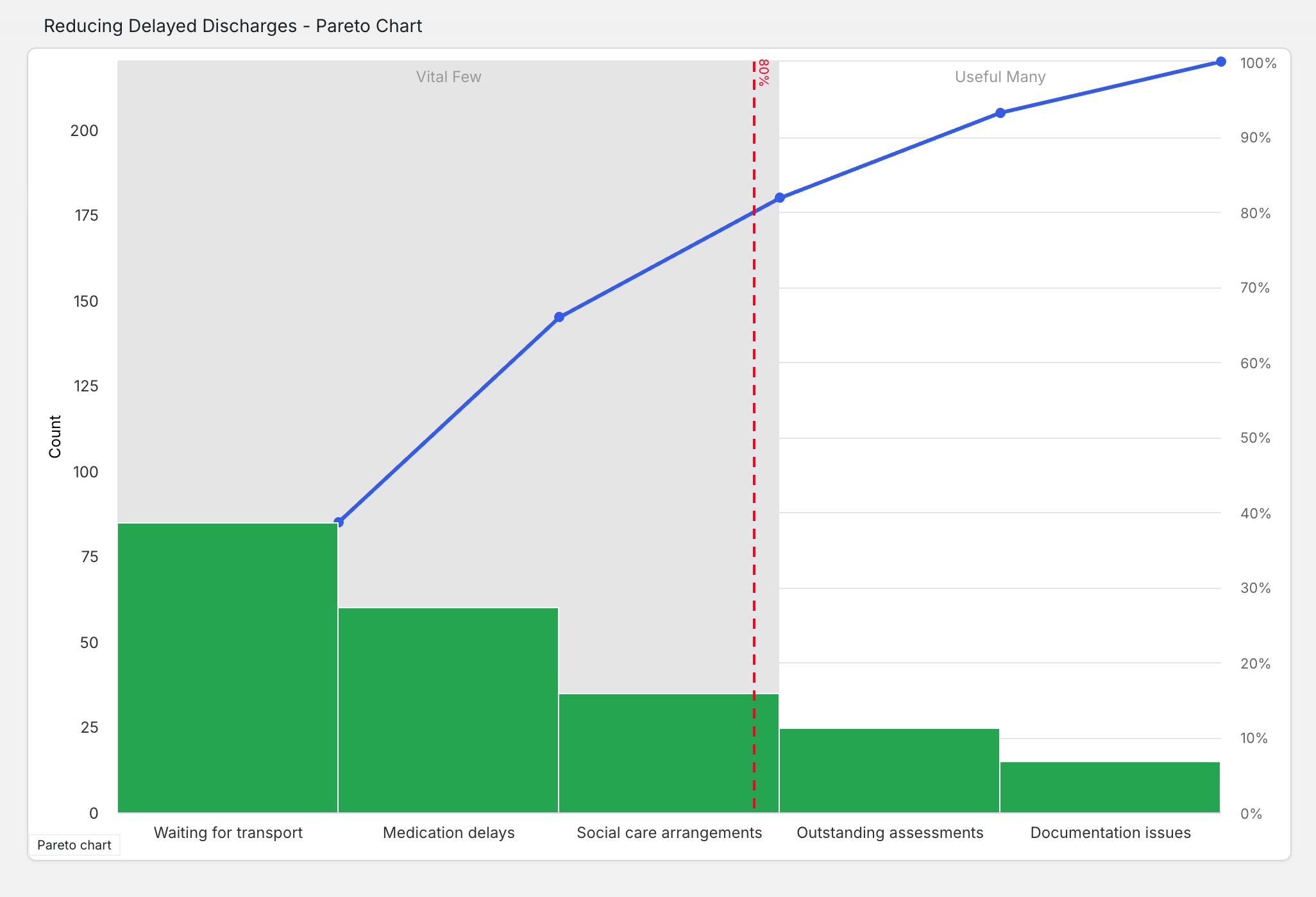 Screenshot of a Discharge Delays pareto chart taken from Simana.
This changes the nature of the discussion.
The team may still need to understand why those delays are happening, but they now have a clearer starting point. Instead of trying to improve every part of the discharge process at once, they can focus first on the areas most likely to reduce the overall number of delays.
Example 2: Patient Complaints
A patient experience team wants to reduce complaints.
The complaints cover a wide range of themes, including waiting times, communication, staff attitude, appointment scheduling, access to services, and information quality.
The team initially assumes that waiting times are the dominant issue because they are mentioned frequently in meetings and are a visible source of frustration.
However, when complaints are categorised and analysed, communication issues emerge as the most common theme.
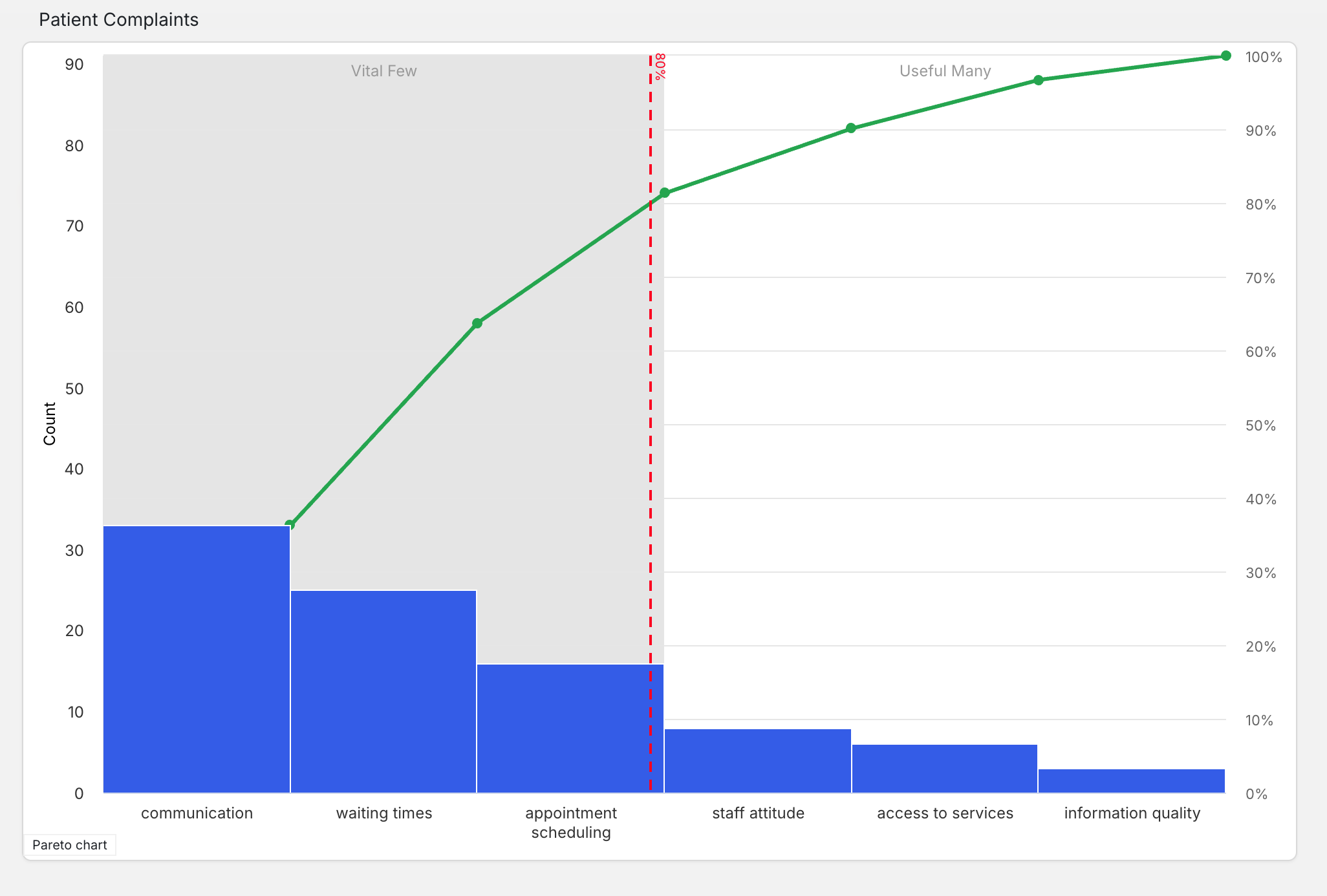 Screenshot of a Patient Complaints pareto chart taken from Simana.
This insight changes the improvement opportunity.
The team may still need to work on waiting times, but the data suggests that communication should be a priority if the goal is to reduce the overall volume of complaints.
The improvement focus might then shift towards clearer appointment information, better updates during delays, improved discharge conversations, or more consistent communication standards across teams.
What High-Performing Improvement Teams Do Differently
High-performing improvement teams do not simply work harder. They make better decisions about where to focus.
They are disciplined about separating the overall problem from its contributing causes. They use data to test assumptions. They make patterns visible. They create shared understanding before jumping into solutions.
This does not mean they wait for perfect evidence. In real improvement work, data is often incomplete, messy, or gathered from operational systems that were not designed for improvement. But even imperfect data can be useful when it is collected consistently and discussed carefully.
The goal is not to remove judgement from improvement work. The goal is to improve judgement by making the evidence easier to see.
Prioritisation Is Also a Team Activity
Prioritisation should not happen in isolation.
A chart or dataset can show where problems appear to be concentrated, but frontline knowledge is still needed to interpret what the data means.
Teams should ask:
- Does this pattern reflect what we see in practice?
- Are the categories meaningful?
- Is the data reliable enough to guide action?
- Are there high-risk issues that need attention even if they occur less often?
- Which causes are within our influence?
- Where could focused improvement work realistically begin?
This is where Pareto analysis is most useful: not as a replacement for team judgement, but as a way to support better conversations.
Frequency Is Not the Only Factor
Pareto charts are especially useful for showing which causes occur most often. But frequency should not be the only consideration when prioritising change.
Some issues may occur less often but carry greater risk, harm, cost, or regulatory significance. Others may be less frequent but highly distressing for patients, families, or staff.
Good prioritisation should consider:
- Frequency
- Severity
- Impact on patients
- Impact on staff
- Risk
- Cost
- Feasibility
- Strategic importance
Pareto charts are therefore best used as part of a wider improvement conversation.
They help teams see where the largest patterns are, but teams still need to decide how those patterns should influence action.
Moving from Priority to Action
Once a team has identified where to focus, the next step is to understand the selected priority in more detail.
If medication delays are a major cause of delayed discharge, the team may need to understand:
- When delays occur
- Which patients are affected
- Which parts of the process contribute
- What information is missing
- Where handoffs break down
- What staff believe would help
The priority identified by the Pareto analysis becomes the starting point for deeper investigation and testing.
From there, teams can develop change ideas, test them on a small scale, and measure whether they are making a difference. (All of which they can easily do in Simana 😉).
The key is that the team is no longer trying to improve everything. It has chosen a focused starting point.
Why This Matters for Sustainable Improvement
Improvement work requires energy, attention, and trust.
When teams repeatedly invest effort without seeing progress, confidence can fall. Staff may become sceptical about improvement initiatives, especially if they feel disconnected from the real issues affecting day-to-day work. Clear prioritisation helps prevent this.
When teams can see why a particular issue has been chosen, they are more likely to understand the rationale for action. When the chosen issue is visibly connected to the wider problem, progress is easier to explain. This helps improvement feel more focused, more credible, and more achievable.
Summary
Prioritisation is one of the most important challenges in improvement work.
Healthcare teams often face many possible problems, all competing for attention. Without a structured way to decide where to focus, effort can become fragmented and impact can be limited.
Pareto charts help teams make better prioritisation decisions by showing which causes contribute most to a problem.
They help teams move beyond assumptions, build shared understanding, and focus effort where it is most likely to make a meaningful difference.
For improvement teams working in complex healthcare environments, that clarity can be the difference between lots of activity and real progress.