


A QI measurement plan sets out what you will measure, how each measure is defined, who will collect the data and how the team will review it. It...
3 months ago

Improvement teams are rarely short of problems to solve.
More often, the challenge is deciding where to start.
When delays, complaints, incidents, and operational challenges all compete for attention, it can be difficult to know which issues deserve focus first. Teams can easily find themselves spreading effort across too many areas or relying on assumptions about what matters most.
A Pareto chart helps bring clarity.
Simple, visual, and grounded in data, Pareto charts help teams identify the factors that contribute most to a problem. Rather than trying to address everything at once, teams can focus on the issues most likely to deliver meaningful improvement.
For healthcare organisations seeking to improve quality, safety, experience, and efficiency, Pareto charts are one of the most practical tools available for turning data into action.
What Is a Pareto Chart?
A Pareto chart is a visual improvement tool that helps teams identify which causes contribute most to a problem.
It combines:
- A bar chart showing the frequency of different causes or categories
- A cumulative percentage line showing how much of the overall problem is explained as causes are added together
The bars are arranged from highest to lowest frequency, making it easy to see which issues occur most often.
Pareto charts are based on the Pareto Principle, sometimes known as the 80/20 rule. While the exact proportions vary, the principle suggests that a relatively small number of causes often account for a large proportion of the effect.
In improvement work, this means that a handful of issues may be responsible for most delays, complaints, incidents, or inefficiencies. A Pareto chart helps teams identify those issues and focus their efforts where they are likely to have the greatest impact.
Pareto Charts at a Glance
|
Best used for |
Prioritising improvement opportunities |
|
Improvement phase |
Understanding and analysing a problem |
|
Data required |
Categorised frequency data |
|
Works well with |
Driver diagrams, PDSA cycles, process mapping |
|
Typical outcome |
Clear priorities for improvement action |
|
Common healthcare uses |
Delayed discharges, patient complaints, medication incidents, waiting times |
Why Pareto Charts Matter in Improvement Work
Improvement teams often begin with long lists of potential problems and causes.
Without a structured way to prioritise, it can be difficult to build agreement about where effort should be directed. Teams may spend significant time debating priorities or investing energy in issues that ultimately have limited impact.
Pareto charts help address this challenge in three important ways:
Focus Effort Where It Matters Most
One of the greatest strengths of a Pareto chart is its ability to bring focus.
Instead of attempting to solve every problem simultaneously, teams can identify the relatively small number of causes responsible for most of the issue they are trying to improve.
This helps teams:
- Focus on high-impact opportunities
- Avoid spreading resources too thinly
- Prioritise change efforts based on evidence
- Increase the likelihood that improvement work delivers meaningful results
Create a Shared Understanding of the Problem
Improvement work is collaborative. Teams often include people with different roles, experiences, and perspectives. A Pareto chart provides a simple visual representation of the data that everyone can understand.
By making patterns visible, Pareto charts help teams:
- Develop a shared understanding of the problem
- Build agreement about priorities
- Reduce reliance on assumptions or anecdotal evidence
- Support productive conversations about improvement opportunities
Support Better Decision-Making
Pareto charts are not simply descriptive tools. Their value comes from helping teams decide what to do next.
When used alongside other improvement methods, Pareto charts provide evidence that helps teams decide:
- Which causes should be investigated further
- Where to focus improvement efforts first
- Which changes are most likely to deliver benefit
- How to allocate limited time and resources
A Healthcare Example: Understanding Delayed Discharges
Imagine a hospital team working to reduce delayed patient discharges. Over several weeks, the team records the primary reason for each delayed discharge and categorises the results.
The data shows:
|
Reason for Delay |
Number of Cases |
|---|---|
|
Waiting for transport |
85 |
|
Medication delays |
60 |
|
Social care arrangements |
35 |
|
Outstanding assessments |
25 |
|
Documentation issues |
15 |
A Pareto chart created from this data would immediately show that transport and medication-related delays account for a significant proportion of all delayed discharges.
Here is how that looks on a Pareto Chart in Simana:
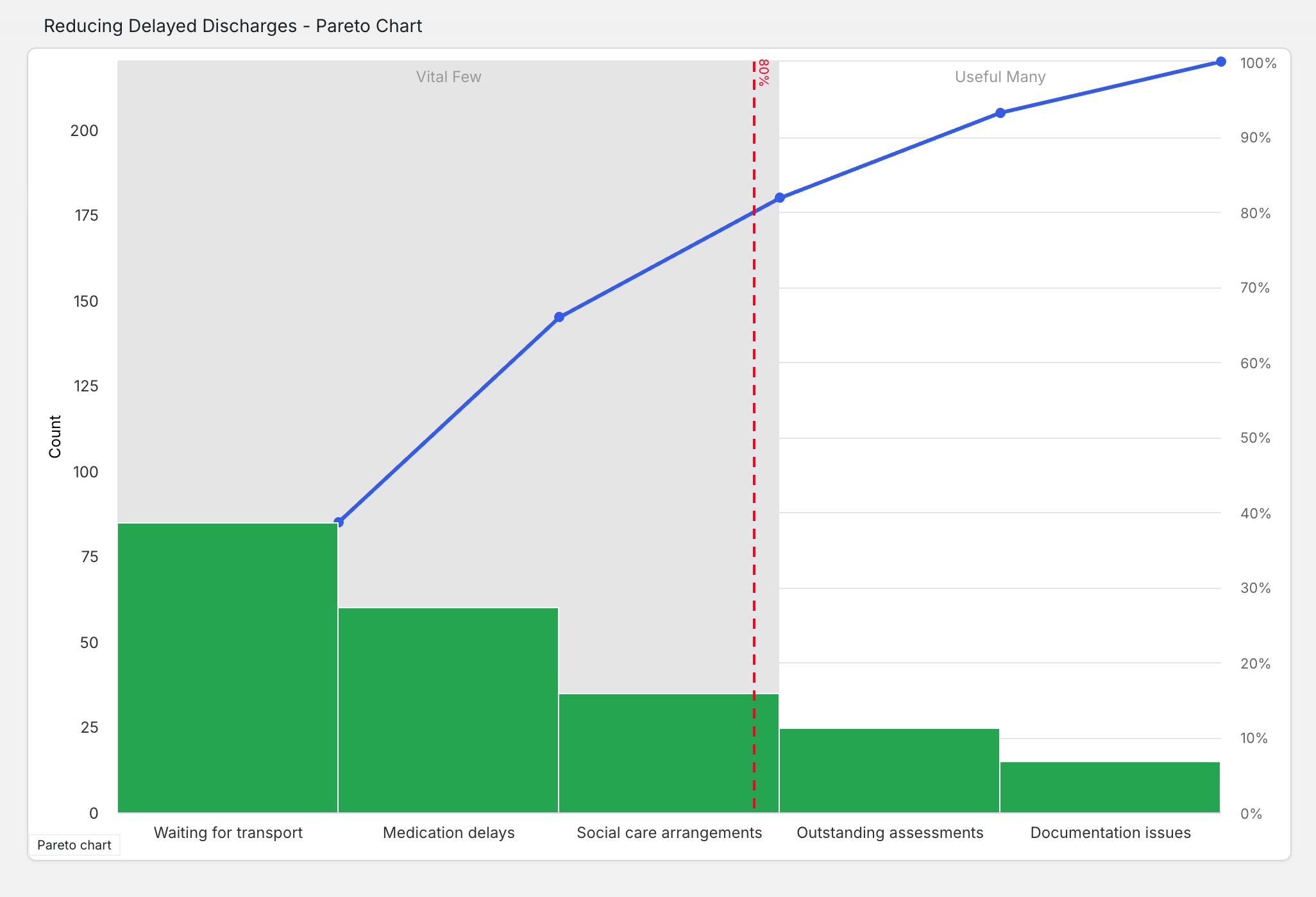 Screenshot of a Discharge Delays pareto chart taken from Simana.
Rather than attempting to address every cause simultaneously, the team can focus initial improvement efforts on these areas.
This allows resources to be directed where they are most likely to improve patient flow and reduce delays.
A similar approach can be used to analyse:
- Patient complaints
- Medication incidents
- Appointment delays
- Emergency department waiting times
- Falls and safety incidents
- Staff experience concerns
How Does a Pareto Chart Work?
Creating a Pareto chart is straightforward, but its value depends on collecting meaningful data and using the results thoughtfully.
Step 1: Define the Problem
Start with a clear and specific problem statement.
Examples include:
- Why are patients experiencing delayed discharge?
- What types of medication incidents occur most frequently?
- What are the most common reasons for patient complaints?
A clearly defined problem helps ensure that everyone is analysing the same issue.
Step 2: Identify Categories
Next, group the data into meaningful categories.
Categories should be:
- Clearly defined
- Mutually exclusive where possible
- Relevant to the people doing the work
For example, medication incidents might be categorised as prescribing errors, dispensing errors, administration errors, and documentation errors.
Step 3: Collect Data
Gather data over an agreed time period.
The quality of the chart depends on the quality of the data, so it is important to use consistent definitions and collection methods.
The goal is not perfect data. The goal is sufficient data to reveal meaningful patterns.
Step 4: Create the Chart
Count the frequency of each category and arrange them from highest to lowest.
The chart displays:
- Bars representing the frequency of each category
- A cumulative percentage line showing the combined contribution of categories
This makes it easy to identify the causes responsible for most of the problem.
Step 5: Prioritise Improvement Efforts
Once patterns become visible, teams can decide where to focus improvement activity.
The chart provides evidence that supports prioritisation and helps teams avoid investing effort in low-impact areas.
Using Pareto Charts Alongside Other Improvement Tools
Pareto charts are most effective when used as part of a broader improvement approach.
Pareto Charts and Driver Diagrams
Pareto analysis can help identify which factors should be explored within a driver diagram.
By highlighting the most significant causes of a problem, teams can focus their driver diagrams on the areas most likely to influence outcomes.
Pareto Charts and PDSA Cycles
Once priority areas have been identified, teams can use Plan-Do-Study-Act (PDSA) cycles to test changes.
The Pareto chart helps answer an important question:
“Which problem should we tackle first?”
PDSA cycles then help answer:
“What change might improve it?”
Pareto Charts and Process Mapping
Process maps help teams understand how work is performed.
Pareto charts help identify where problems occur most frequently.
Together, these tools help teams understand both the causes of problems and the processes that contribute to them.
Common Mistakes When Using Pareto Charts
Pareto charts are simple, but there are several common mistakes that can reduce their usefulness.
Using Too Many Categories
When data is divided into too many categories, patterns become difficult to identify.
Focus on categories that are meaningful and actionable.
Using Inconsistent Definitions
If different people interpret categories differently, the resulting data may be unreliable.
Agree definitions before data collection begins.
Collecting Too Little Data
Small datasets can produce misleading results.
Collect enough information to reveal genuine patterns rather than isolated events.
Treating the Chart as the Answer
A Pareto chart helps identify priorities. It does not explain why problems occur or what changes should be made.
The chart should be the beginning of investigation and improvement, not the end.
Frequently Asked Questions
What is the Pareto Principle?
The Pareto Principle suggests that a relatively small number of causes often account for a large proportion of outcomes. It is commonly referred to as the 80/20 rule, although the exact proportions vary between situations.
What is the difference between a Pareto chart and a bar chart?
A Pareto chart is a specialised form of bar chart. The bars are ordered from highest to lowest frequency and are combined with a cumulative percentage line, making it easier to identify priorities.
When should you use a Pareto chart?
Pareto charts are most useful when teams need to understand which causes contribute most to a problem and where improvement efforts should be focused.
Can Pareto charts be used in healthcare?
Yes. Pareto charts are widely used across healthcare improvement, patient safety, operational improvement, quality management, and service redesign.
What data is needed for a Pareto chart?
A Pareto chart requires data that can be grouped into categories and counted. Examples include incident types, complaint themes, causes of delay, or reasons for rework.
Summary
Pareto charts are a simple but powerful way to bring focus to improvement work.
By making patterns visible, they help teams move from long lists of problems to clear priorities grounded in evidence.
Whether the goal is reducing delays, improving patient safety, enhancing experience, or increasing efficiency, Pareto charts help improvement teams identify where effort is most likely to make a difference.
In environments where resources are limited and competing priorities are common, that focus can be invaluable.