


Healthcare teams solve problems every day. A patient falls despite precautions being in place. A discharge is delayed. A clinic overruns. Medication...
2 months ago
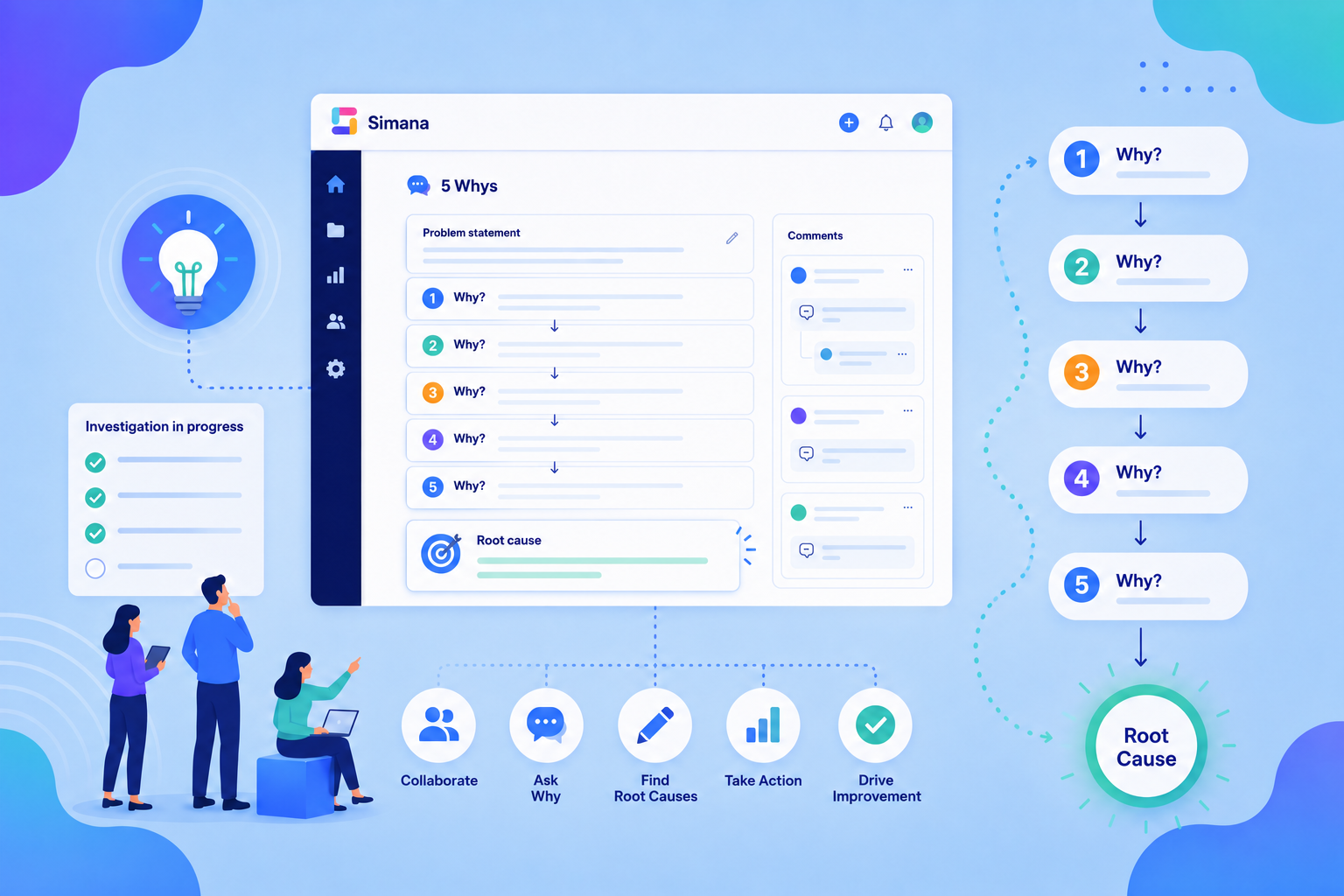
Investigating problems is an essential part of improvement.
Whether you're trying to reduce patient falls, improve discharge planning or understand why a quality measure has deteriorated, the challenge isn't simply documenting what happened. It's helping the right people ask better questions, gather evidence, collaborate effectively and turn what they've learned into meaningful improvement.
Many organisations still conduct 5 Whys investigations using Word documents, spreadsheets or paper templates. While these approaches capture the conversation, they often become disconnected from the improvement work that follows. The investigation sits in one place, actions are tracked somewhere else and valuable learning is difficult to find once the project has finished.
Simana takes a different approach.
Rather than treating a 5 Whys analysis as a standalone document, Simana makes it part of the improvement project itself. Root cause investigations, collaboration, AI assistance, actions, measures and improvement tools all sit together in one connected workspace.
The result is a simpler process for teams today and a richer source of organisational learning tomorrow.
Why Run Your 5 Whys Analysis in Simana?
The real value of a digital improvement platform isn't replacing a paper template. It's connecting every stage of the investigation with the wider improvement journey.
Running your 5 Whys investigation in Simana means:
- keeping the investigation alongside the rest of the improvement project
- creating a single source of truth for the team
- collaborating in one shared workspace instead of emailing documents backwards and forwards
- linking root causes directly to improvement plans, actions and measures
- maintaining a complete history of decisions and discussions
- making investigations easy to revisit and learn from in the future
Instead of becoming another document stored in a shared drive, every investigation becomes a living part of the project's story.
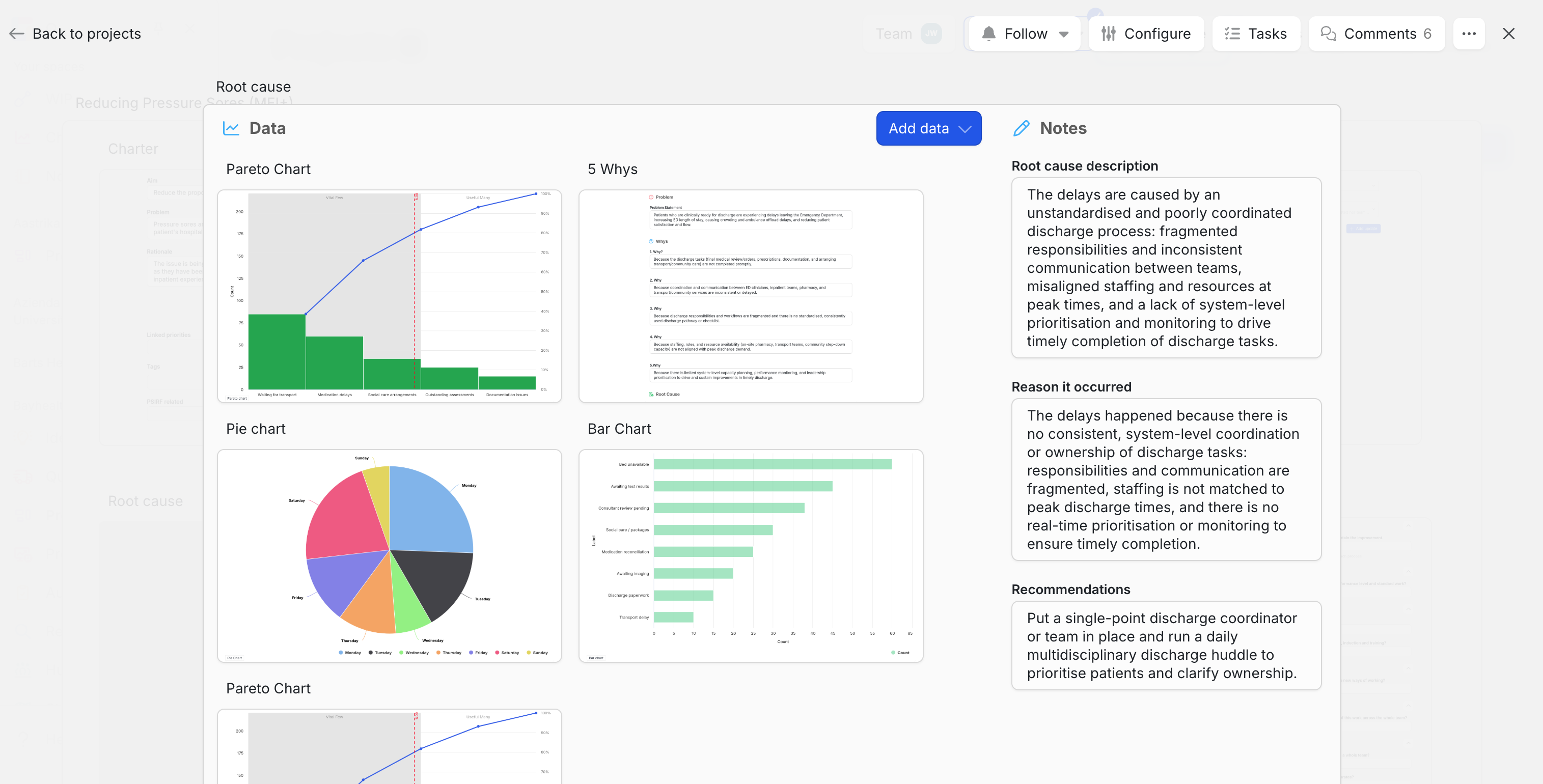 Simana screenshot: A completed 5 Whys tool alongside other root cause tools in the Root cause section of a project.
Starting a 5 Whys Investigation
Getting started should never become a barrier to investigating a problem.
Adding a 5 Whys analysis in Simana takes only a few moments. From within your improvement project, simply add the 5 Whys tool, give it a title and record the problem you're trying to understand.
Rather than describing the process, here's how quickly it can be done.
Because the investigation lives within the project itself, everyone involved has immediate access to the latest version. There are no separate files to manage, no uncertainty about which document is current and no need to duplicate information elsewhere.
The investigation becomes another connected part of the improvement journey from the very beginning.
Capturing Better Root Cause Analysis
A good investigation needs more than five empty text boxes.
Simana provides a structured workspace where teams can capture every stage of their thinking. Alongside each "Why?" and answer, teams can discuss and debate in the Comments thread, assign and manage Tasks, and add a clear summary of the underlying root cause they've identified.
The structure encourages consistent investigations while remaining flexible enough to reflect the realities of improvement work.
Everything is recorded within the project, creating a clear record of how the team's understanding evolved over time.
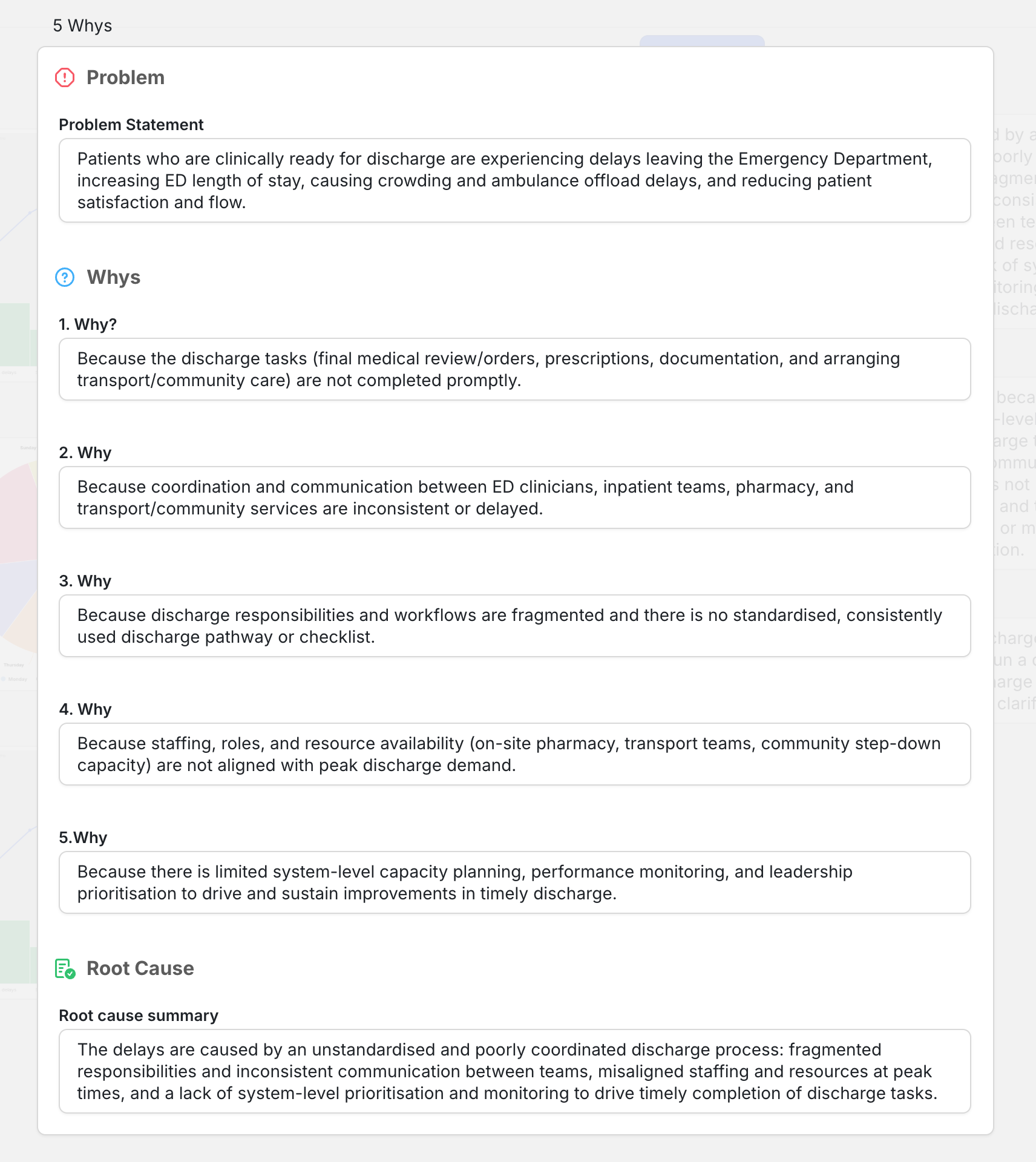 Simana screenshot: A completed 5 Whys investigation showing the problem statement, 5 Why answers, and a root cause summary.
Collaborating on the Investigation
The best investigations rarely happen in isolation.
Understanding why a problem occurred often requires input from clinicians, operational managers, administrators, improvement advisors and the people closest to the work itself.
Simana makes that collaboration straightforward.
Project members can discuss the investigation using comments, mention colleagues with @mentions, upload supporting documents, share photographs or evidence and capture important decisions as the investigation progresses. Instead of circulating multiple versions of a document, everyone contributes within the same shared workspace.
Different perspectives often uncover different insights. A pharmacist may identify issues with prescribing workflows. A ward manager may recognise operational constraints. An improvement advisor may spot patterns seen elsewhere in the organisation. Bringing these perspectives together produces richer investigations and stronger improvement ideas.
Screenshot: Comment thread showing team collaboration, @mentions and supporting evidence attached to the investigation.
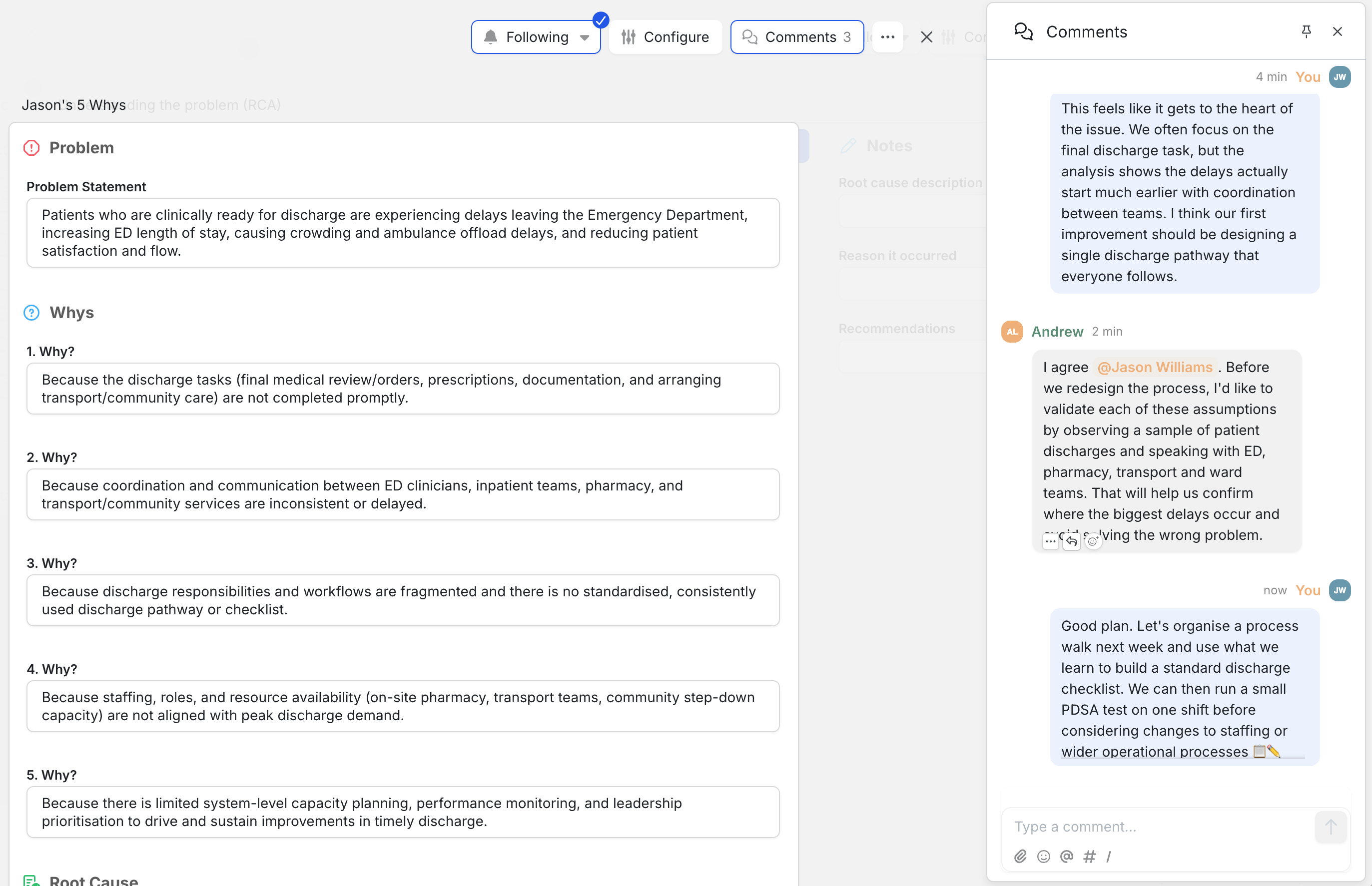 Simana screenshot: Comment thread showing team collaboration around the 5 Whys investigation.
Using Simana AI to Explore Root Causes
One of the biggest challenges during any investigation is knowing whether you've stopped exploring too soon.
Simana AI acts as an always-available improvement companion, helping teams think more critically about the problem they're investigating.
For example, you might ask:
- Have we stopped asking "Why?" too early?
- What assumptions are we making?
- Could there be alternative explanations?
- What evidence would strengthen this investigation?
- What themes emerge from these answers?
- Can you summarise this investigation for our steering group?
- Which improvement tools should we consider next?
Rather than replacing the team's judgement, Simana AI helps prompt deeper thinking, challenge assumptions and reduce the risk of stopping at the first plausible explanation. It supports better conversations, not automated conclusions.
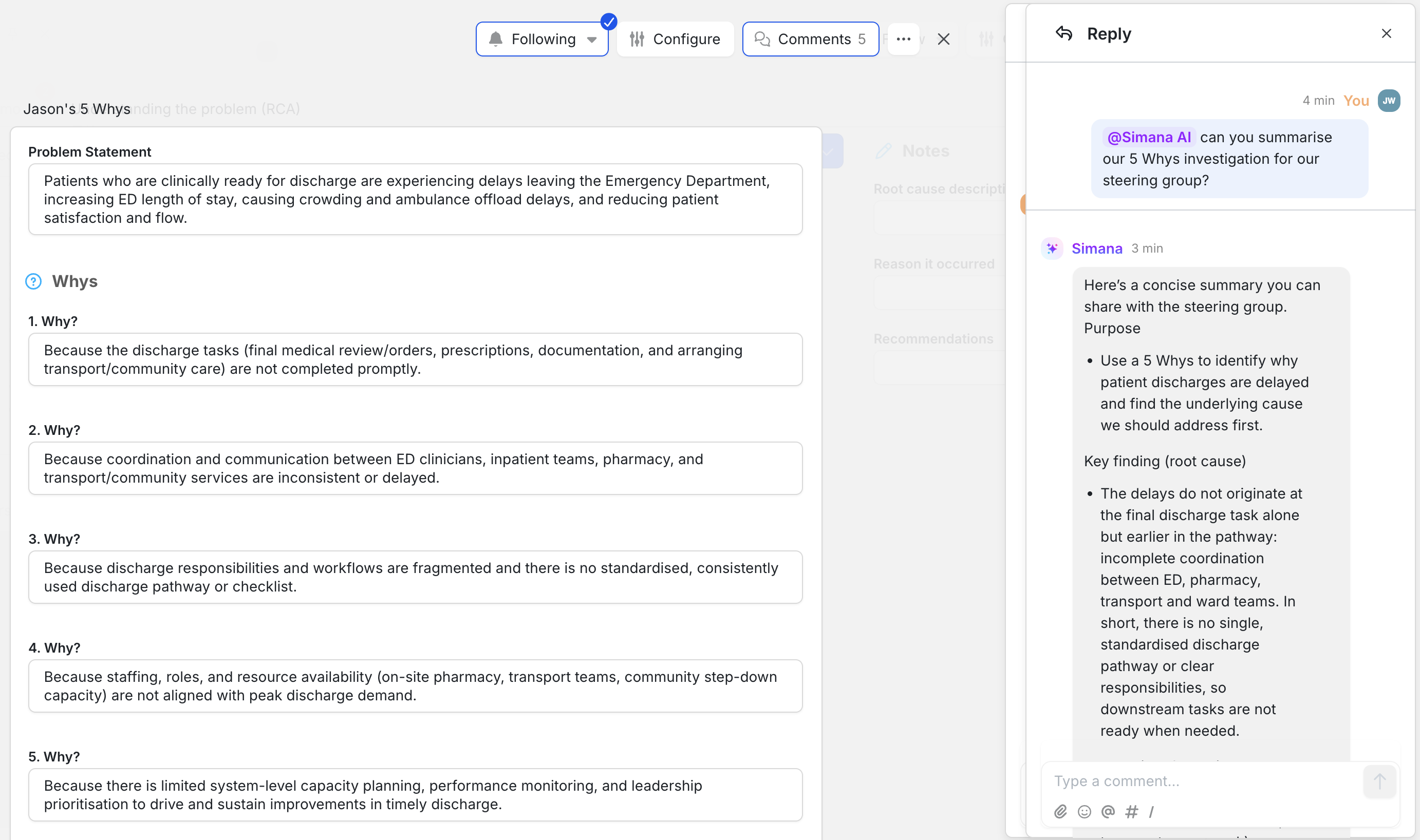 Simana screenshot: Simana AI produces a concise summary of the 5 Whys investigation that can be shared with stakeholders.
Turning Root Causes into Improvement
A root cause investigation is only valuable if it leads to better outcomes.
Once the team understands why the problem occurs, Simana makes it easy to move directly into planning and delivering improvement.
Teams can:
- create a Driver Diagram to explore possible change ideas
- assign actions to project members
- plan and run PDSA cycles
- define outcome, process and balancing measures
- monitor progress using SPC charts and other measurement tools
- review how changes influence results over time
Because every element sits within the same project, there is no disconnect between investigation and implementation. Understanding naturally becomes action.
Sharing Learning Across the Organisation
Every investigation represents valuable organisational knowledge.
Yet in many organisations, that knowledge disappears once the project ends. Reports are archived. Documents become difficult to find. Future teams unknowingly investigate the same problems all over again. Simana helps organisations retain and build on that learning.
Completed investigations remain searchable alongside every other improvement project, allowing teams to revisit previous work, compare similar challenges and learn from successful approaches used elsewhere.
Over time, this creates an increasingly valuable knowledge base that helps organisations improve more consistently and avoid repeating the same investigations. Improvement doesn't just happen project by project. It becomes organisational learning.
A Practical Example
Imagine a hospital team investigating repeated delays in patient discharge.
They begin by adding a 5 Whys investigation to their discharge improvement project and recording the problem statement. As the multidisciplinary team works through each "Why?", they collaborate using comments, upload supporting evidence and ask Simana AI whether any assumptions remain untested.
The investigation reveals that pharmacy turnaround times are only part of the issue. The more significant cause is that discharge planning consistently starts too late in the patient's journey.
Rather than simply asking pharmacy to work faster, the team creates a Driver Diagram focused on improving early discharge planning, assigns actions to ward staff, designs several PDSA cycles and begins measuring the impact using SPC charts.
The investigation doesn't end with identifying the root cause. It becomes the foundation for meaningful improvement.
Summary
The purpose of the 5 Whys isn't to complete another template. It's to understand problems well enough to improve the system.
Simana provides a collaborative workspace where investigations, evidence, discussion, AI guidance and improvement work remain connected throughout the life of the project.
Instead of producing standalone documents that are quickly forgotten, teams create shared understanding that leads directly to action, learning and lasting improvement.
By keeping root cause analysis connected to the wider improvement journey, Simana helps organisations investigate better, learn faster and improve with greater confidence.